Cotton & Gray
Goldendoodles & Flowers


Doodle-Lingo
Goldendoodle Terminology Translated to plain English
We get a lot of questions about Goldendoodles and the terminology that surrounds them! The language of the doodle world can sometimes make one dizzy. Below, we break it down to help you understand doodle-lingo, but also help you understand why we do some of the things we do with our pups here at Cotton & Gray. We hope that being able to break this terminology down will help you determine what type of Goldendoodle would be the best fit for your family, your home and lifestyle.

Hybrid - Crossbreed - Designer
The Goldendoodle is a product of breeding a purebred Golden Retriever with a purebred Poodle. This is what, in the dog world, is referred to as a "hybrid", "cross breed" or "designer breed". A Filial Hybrid is a product that is a result of two distinct parents. In the case of the Goldendoodle, it is the result of breeding a Golden Retriever and a Poodle. Although not recognized by AKC, designer breeds are recognized by reputable canine registries such as APR and ICA.
F1 - F1b - F1bb, etc...
Breaking it down
These terms above are used to define the product of the parent breeding combination.
* The F stands for Filial, which comes from the Latin, meaning of or relating to son or daughter.
* The Number following the F indicates the generation.
* The b following the number indicates Backcross

F1
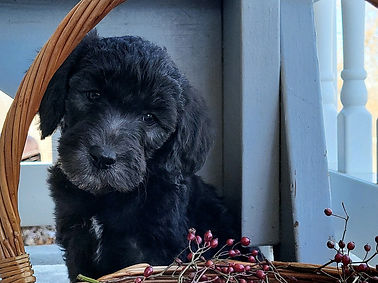
Our Sire, Jack, is an F1 Goldendoodle. His mama is a Golden Retriever, his papa is a Poodle. He is also known as a First Generation Goldendoodle. F1 Goldendoodles will typically have a more wavy, less curly, coat. They can also come with furnishings (see explanation below) that give them that classic teddy-bear look. The F1 will shed and is the least hypoallergenic of the Goldendoodles. In Jack's coat, you can see the hair he inherited from his dam, straight, and the hair he inherited from his sire, wavy. Although his coat is the least hypoallergenic of the Goldendoodle generations, it is the easiest to maintain.
F1b
F1b comes as a result of breeding an F1 Goldendoodle, such as Jack, back to a purebred parent, either a golden retriever, or a poodle. In most cases, the F1 Goldendoodle is backcrossed with a Poodle. Here at Cotton & Gray, Jack, our F1 Goldendoodle, was bred with our purebred poodle, Hazel. The product is F1b Goldendoodle puppies. This product yields a puppy that is 75% Poodle, 25% Golden Retriever. The result of this combination is a dog with a more hypoallergenic coat with minimal shedding and, yes, that beloved Goldendoodle teddy-bear look.

F1bb
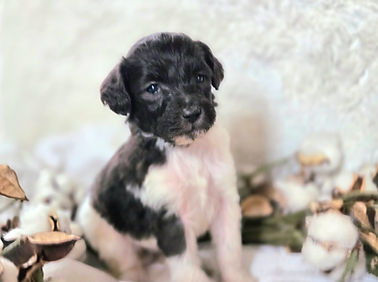
F1bb is the result of breeding a F1b Goldendoodle back with a purebred poodle; yielding puppies that have 87.5% poodle genes and 12.5% Golden Retriever genes. This generation of Goldendoodle is a little harder to find, but also the more sought after for being the most hypoallergenic of the Goldendoodle generations. This breed will have tighter curls, yet still maintain that highly sought after, cute as can be, teddy-bear look.
Furnishings
Goldendoodles can come with what is called "furnishings". Yes, it is a thing. And it is what gives the Goldendoodle's face that classic, loveable, shaggy look. Furnishings refer to the hair on the face; the eyebrows, the mustache, and fluffy beards. Some Goldendoodles take after the Golden Retriever parent and have what is called a "flat" or "improper" coat. This gene, which comes from the Retriever parent, is not at all a negative aspect of the Goldendoodle. In fact, there are those that seek this coat on the Goldendoodle because the coat upkeep is less involved.

Hair color

The most common Goldendoodle colors are apricot, cream and red. But there is a whole array of colors and patterns Goldendoodles can come in. Some of our customers have been surprised to know we have black, silver, and merle pups. With the stronger Poodle genes, found in the F1b and the F1bb, the more diversified the coats become. Some of these, like silver, parti, merle and phantom, are more unusual and even rare in the doodle world. There is a whole genetic science behind this, but we are trying to keep it simple here. Remember, we are just breaking down Doodle-Lingo into plain English!
Clearing
Clearing is when a puppy's coat starts to change to it's adult coat color. This starts occurring at about 6 weeks of age. This change can be subtle; an apricot Goldendoodle may lighten to a cream as it gets older. Some clearing is more dramatic, like a black puppy that "clears" to silver or blue. It can take about 2 years for some Goldendoodles to clear to their complete adult coat color. Clearing usually begins in the muzzle, around the eyes and in the feet and legs. It is exciting to see how they change as they grow!


All photographs are property of Cotton & Gray Goats and Goldendoodles LLC.
No images may be copied or used without permission.